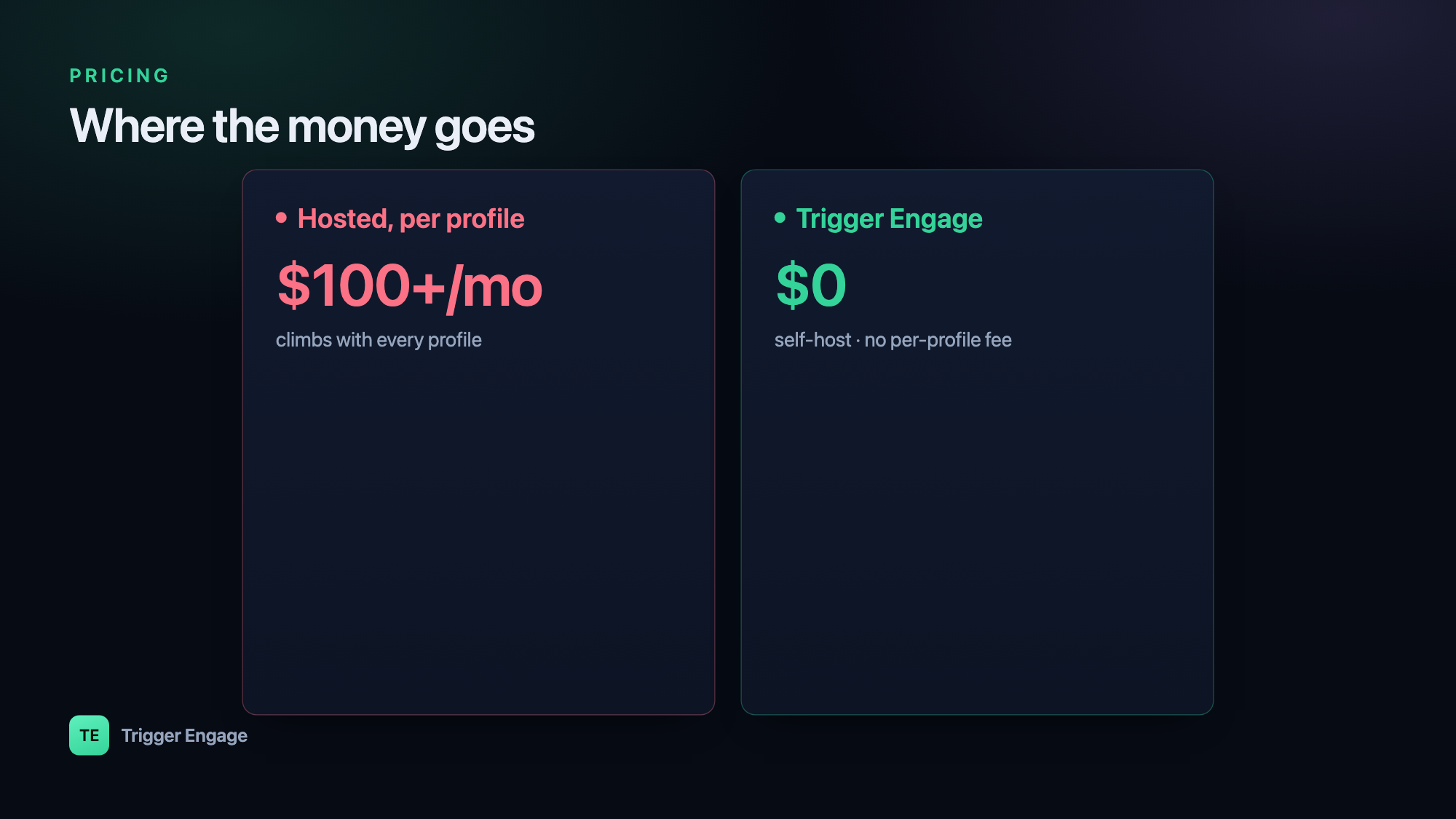
Customer.io is an excellent lifecycle-messaging tool, but its per-profile pricing — the entry plan starts around $100/month and climbs with every profile you store — sends plenty of teams looking for something that scales differently. If you are weighing Customer.io alternatives, the right pick depends less on feature checklists and more on how each tool bills you, which channels it sends on, and whether you can own the data. This guide compares nine of them — including two free, open-source Customer.io alternatives you can self-host — by the things that actually matter.
What to look for in a Customer.io alternative
Most comparison posts drown you in feature grids. In practice, the choice of a Customer.io alternative comes down to five questions. Answer these first and the shortlist writes itself.
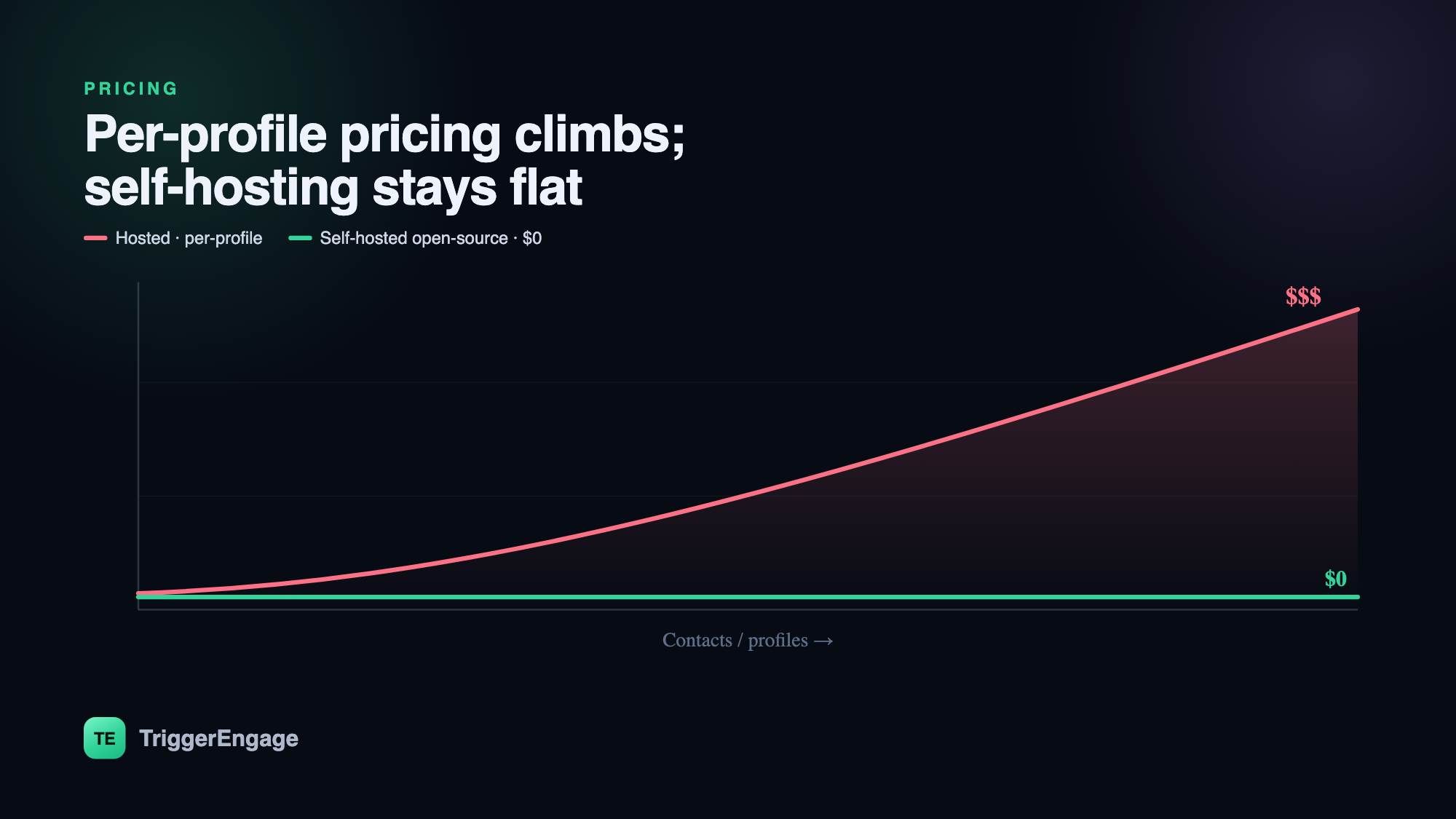
- Pricing model. Per-profile (or per-contact) billing means your bill grows as your audience grows, whether or not those people ever open a message. Flat and free models decouple cost from list size. This is the single biggest reason people leave Customer.io.
- Channels. Do you need email only, or email plus SMS and push? Cross-channel tools cost more but save you from stitching several vendors together.
- Automation depth. Look for visual journeys, branching logic, time delays and wait steps, and built-in A/B testing. Shallow tools force your app code to do the orchestration.
- Data ownership and self-hosting. If you handle sensitive data or want to avoid vendor lock-in, an open-source, self-hosted Customer.io alternative keeps profiles on infrastructure you control.
- Developer experience. A clean SDK or API, sensible event model, and support for anonymous-to-identified tracking determine how quickly you can ship. If you are wiring up event-based emails in Laravel, this matters more than any dashboard.
The 9 best Customer.io alternatives in 2026
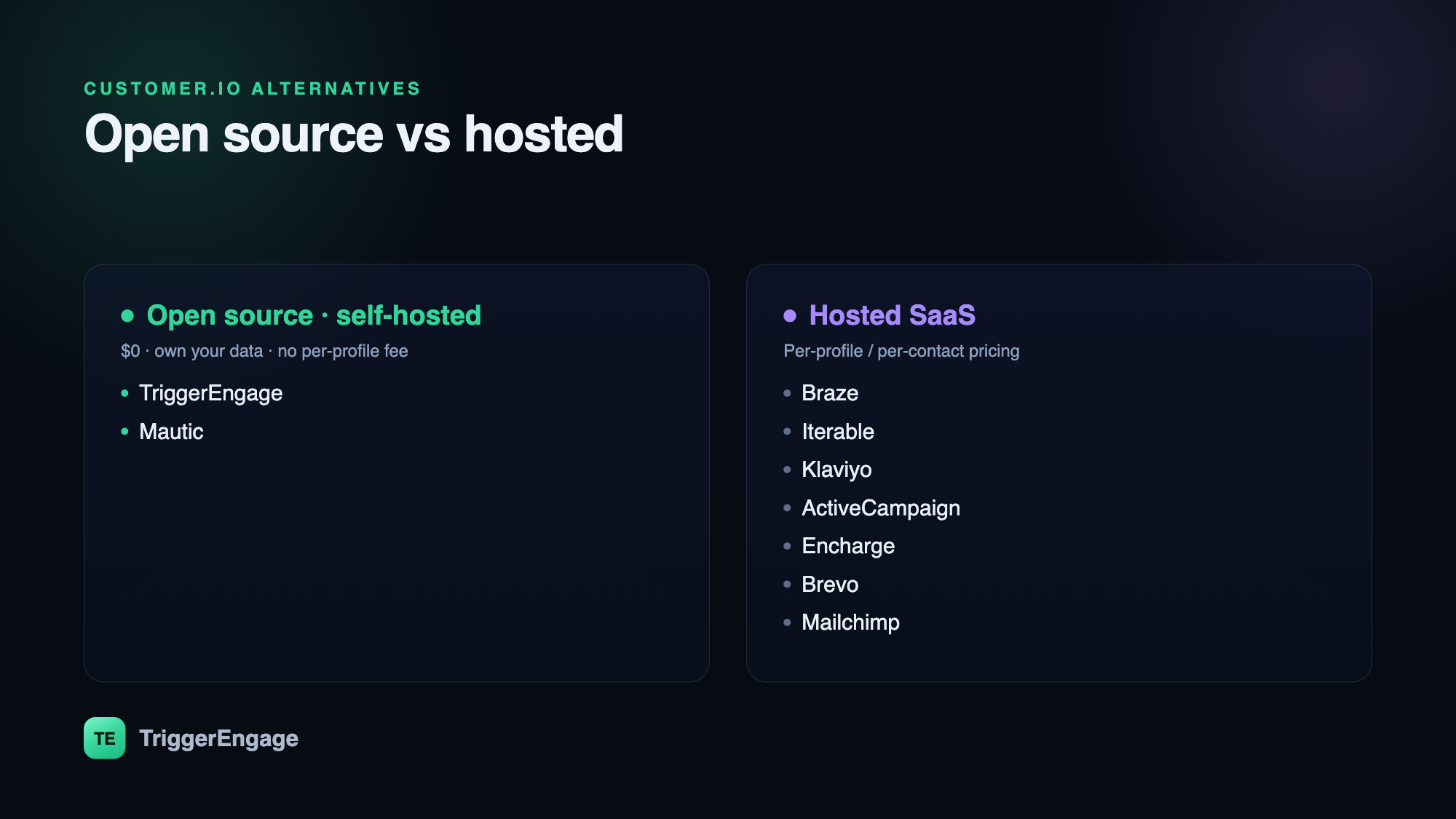
The tools below span the full range — from free, open-source projects you self-host to enterprise platforms with sales teams. Two of the nine are open-source Customer.io alternatives you can run yourself; the rest are hosted SaaS and enterprise options. Read the "best for" line as much as the description, and you can compare TriggerEngage against each of these alternatives head-to-head.
1. TriggerEngage — the best open-source Customer.io alternative
TriggerEngage is an MIT-licensed, open-source Customer.io alternative built for Laravel teams. It is free and carries no per-profile fee — you either self-host it or embed it directly in your Laravel app with composer require trigger-engage/server. Because you run it on your own infrastructure, your profile data never leaves your control. For a feature-by-feature breakdown, see our TriggerEngage vs Customer.io comparison.
Feature-wise it covers the workflow you would expect from a hosted tool: visual journeys with branching and waits, behavioral segments, A/B testing, anonymous-to-identified tracking, and analytics. It sends on email (SMTP, Amazon SES, Mailgun, Postmark), SMS (Termii), and push (OneSignal).
Best for: Laravel teams who want to own their data and stop paying per profile as their user base grows.
2. Mautic — the established open-source option
Mautic is the best-known open-source marketing-automation platform: a free, self-hostable suite with email campaigns, landing pages, forms, and lead scoring. It is broader than TriggerEngage but heavier to run, and it is built around a standalone Symfony application rather than living inside your own app. Both are open-source Customer.io alternatives with no per-contact fee — see TriggerEngage vs Mautic for the trade-offs.
Best for: marketing teams that want a full, self-hosted marketing suite and don't mind operating it.
3. Braze
Braze is an enterprise customer-engagement platform aimed at large consumer brands. Its strength is cross-channel orchestration at scale — email, push, in-app, and more from one place — with the deep analytics and services that big teams expect. Pricing is enterprise and sales-led, quoted per engagement rather than published. For a feature-by-feature look, see TriggerEngage vs Braze.
Best for: large consumer brands with the budget and headcount for an enterprise platform.
4. Iterable
Iterable is another enterprise cross-channel marketing-automation platform, positioned for growth and marketing teams operating at scale. Like Braze, it leans on cross-channel campaigns and experimentation, and its pricing is sales-led rather than self-serve. See TriggerEngage vs Iterable.
Best for: growth and marketing teams at scale who want a full enterprise suite.
5. Klaviyo
Klaviyo is a marketing-automation tool with a deep e-commerce focus and tight Shopify integration. It is built around store data — orders, products, browsing — which makes it strong for abandoned-cart and post-purchase flows. Klaviyo uses per-contact pricing, so your cost rises with the size of your list. Compare them directly: TriggerEngage vs Klaviyo.
Best for: online stores, especially on Shopify, that want e-commerce flows out of the box.
6. ActiveCampaign
ActiveCampaign pairs marketing automation with a built-in CRM, aimed at small and mid-size businesses. Its automation builder is well-regarded and it adds sales pipelines on top of email — but it is hosted and priced per contact. See TriggerEngage vs ActiveCampaign.
Best for: SMBs that want marketing automation and a light CRM in one tool.
7. Encharge
Encharge is a marketing-automation tool aimed at SaaS companies, with a visual flow builder for onboarding and lifecycle campaigns. It sits in the mid-market and uses contact-based pricing, making it a lighter, more affordable pick than the enterprise platforms. Compare them: TriggerEngage vs Encharge.
Best for: mid-market SaaS teams that want a flow builder without an enterprise contract.
8. Brevo
Brevo (formerly Sendinblue) is an affordable, hosted email and SMS platform with a free tier and transactional sending built in. It is a practical all-rounder for small senders, though it is metered by sends and contacts and is more campaign-oriented than event-driven. See TriggerEngage vs Brevo.
Best for: small teams that want email and SMS together in one budget-friendly hosted tool.
9. Mailchimp
Mailchimp is the broad, well-known email-marketing tool, with some automation layered on top. It is approachable and widely supported, with contact-based tiers that scale as your audience grows. It is less of an event-driven lifecycle engine and more of a newsletter-plus-basics platform. See TriggerEngage vs Mailchimp for the details.
Best for: simple newsletters and small businesses stepping up from the basics.
Customer.io alternatives compared at a glance
| Tool | Pricing model | Channels | Open source | Self-host | Best for |
|---|---|---|---|---|---|
| TriggerEngage | Free (no per-profile fee) | Email, SMS, push | Yes | Yes | Laravel teams owning their data |
| Mautic | Free, open source | Email (SMS/push via plugins) | Yes | Yes | Full self-hosted marketing suite |
| Braze | Enterprise, sales-led | Email, push, in-app, more | No | No | Large consumer brands |
| Iterable | Enterprise, sales-led | Email, SMS, push, more | No | No | Growth teams at scale |
| Klaviyo | Per-contact | Email, SMS | No | No | E-commerce / Shopify stores |
| ActiveCampaign | Per-contact | Email, SMS | No | No | SMBs wanting automation + CRM |
| Encharge | Contact-based | No | No | Mid-market SaaS | |
| Brevo | Per-send / free tier | Email, SMS | No | No | Budget email + SMS |
| Mailchimp | Contact-based tiers | No | No | Newsletters, small business |
How to choose the right Customer.io alternative
Match the decision to your constraint rather than the longest feature list:
- You need to own your data or avoid per-profile fees. Choose an open-source, self-hosted Customer.io alternative — TriggerEngage or Mautic. You keep profiles on your own infrastructure and decouple cost from list size.
- You are at enterprise scale and want managed services. Braze or Iterable give you cross-channel orchestration and a support team, at enterprise pricing.
- You run an online store. Klaviyo's e-commerce and Shopify depth is hard to beat for cart and post-purchase flows.
- You want automation plus a CRM, or email + SMS on a budget. ActiveCampaign bundles a CRM; Brevo keeps hosted email and SMS affordable.
- You mostly send newsletters. Mailchimp keeps things simple and familiar for small teams.
- You have a Laravel app and want messaging embedded in it. TriggerEngage installs with Composer and runs inside your stack, so your behavioral segmentation and journeys live next to your application data.
Whichever way you lean, test with a real flow before committing. Pick one high-value journey — a welcome series or a re-engagement campaign — build it end to end, and see how the pricing, channels, and automation hold up against your actual event data. That single test tells you more than any comparison table, this one included. If you're already sold on owning the stack, our guide to migrating from Customer.io walks through the move step by step.
Frequently asked questions
What is the best open-source Customer.io alternative?
Is there a free Customer.io alternative?
Can I self-host a Customer.io alternative?
composer require trigger-engage/server, which keeps all profile data on infrastructure you control. Mautic is also self-hostable. The hosted SaaS and enterprise options in this list — Braze, Iterable, Klaviyo, ActiveCampaign, Encharge, Brevo, and Mailchimp — are hosted-only.